 Blu Blog
A Lawsuit Against the Girl Scouts
Tue 11 March 2025The news
A friend of mine texted me "did you hear the girl scout cookies have lead in them? Someone's suing about it!" Lemme tell ya, little piques my interest quite like that kind of comment. I found this reuters article about it, and some of the details made me even piqueder. Particularly this statement about the plaintiff, Amy Mayo:
She said she would not have bought the cookies or "would have paid substantially less" had Girl Scouts disclosed the presence of "dangerous toxins."
That phrasing looks like someone buying cookies to make sure they have established cause. With a statement like that, you can set up that you bought something, you feel mislead, and now have scientific evidence that you were harmed.
So I looked into Amy Mayo suing in federal court in Brooklyn. Is she affiliated with GMOScience or Moms Across America? I thought she must be, but couldn't find anything conclusively. But regardless of that, it seems like this study is being used to manufacture a case, so let's take a closer look at the study.
The study
Direct link here. Starts with these concrete claims:
- 100% of the samples were positive for glyphosate
- 100% were positive for toxic metals
- 22 out of 25 (88%) of samples were positive for all 5 toxic metals
- 76% were positive for levels of cadmium that exceed EPA limits in water
- 24 out of 25 (96%) of samples were positive for lead
If 100% of samples had glyphosate, that raises some further questions that need answering. Do other foods commonly test positive, thus making this less meaningful? Did you miscalibrate your machine? Was there a mixup with the test data? 100% detection rate on its own doesn't give nearly enough information.
And about the glyphosate levels found:
From 13.57 ppb in Peanut Butter Patties® to 111.07 in Thin Mints®, the average amount is 33.43, 334 times higher than what Dr. Don Huber, Professor Emeritus of Purdue, states is harmful and must be avoided
Note that their 111.07 ppb is a calculated "effective glyphosate level" that uh... is not defined or probably worth a damn. On top of that, their citation is Dr. Don Huber, who is a person and not a study. It's not even a citation to a book, blog post, or napkin scribbles that Huber made. It's just "hey this guy thinks something", which is an appeal to authority rather than any evidence.
They also claim that the cookies contain "very elevated levels of glyphosate" which, again, without tests of other 'acceptable' foods tells us nothing. Elevated compared to what? What threshold does elevated become very elevated at?
On to the heavy metal bits, lets look at their table of results:
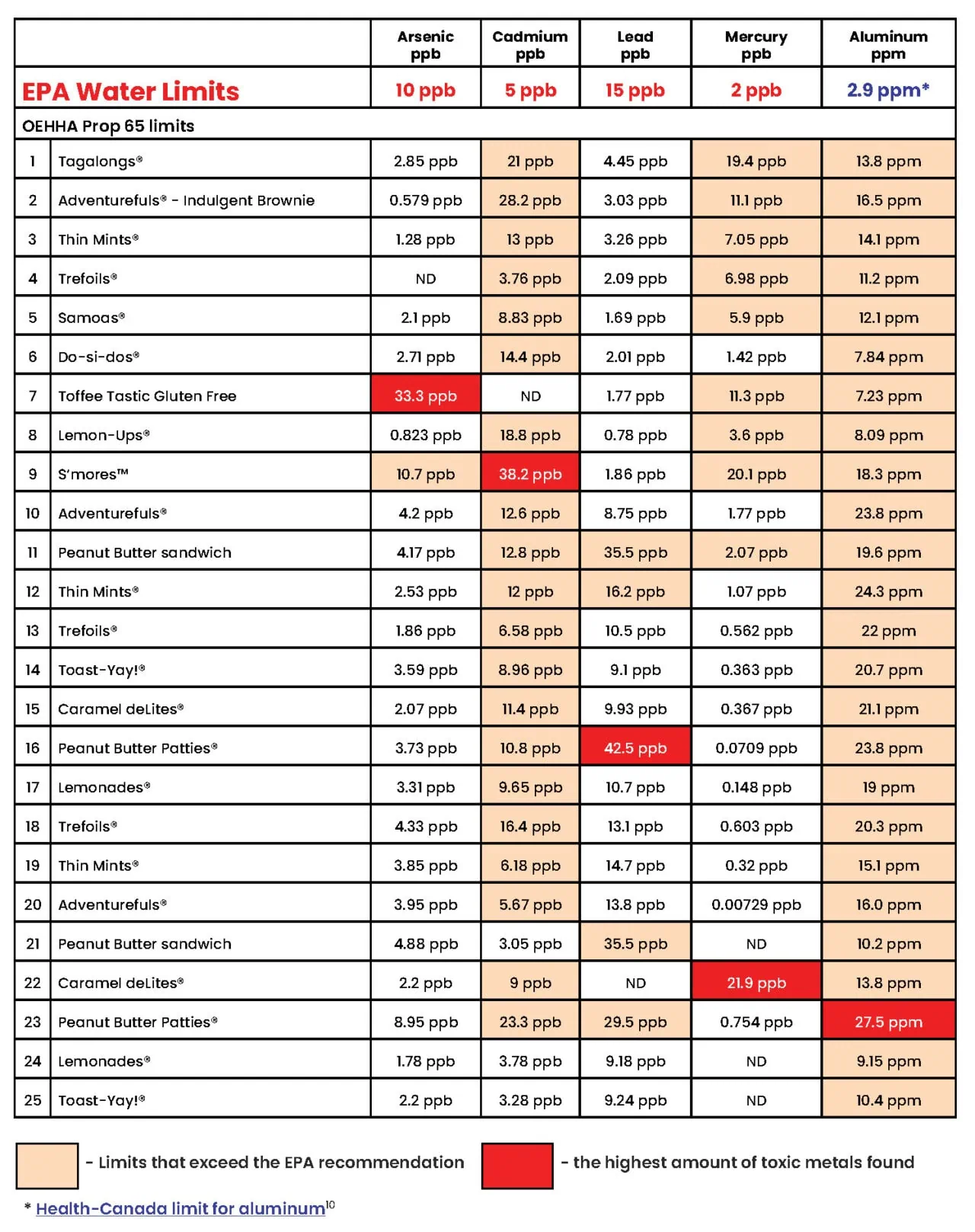
It's important to note that 1) this table compares to regulatory levels of metals for water and not food and 2) the EPA doesn't actually have a comparable table for food. This second point is, in my opinion, a huge mistake that the US federal government has been consistently making for a very long time. To the first point, though: since the body processes food and water differently and in different quantities, we need a table of values for food, not water. So we'll be looking at maximum allowable doses from European regulations. The following table compares max contaminant levels found in cookies with EU regulations:
| contaminant | Highest level found | EU food limit |
|---|---|---|
| arsenic | 33.3 ppb | 150 ppb |
| cadmium | 38.2 ppb | 150 ppb |
| lead | 42.5 ppb | 200 ppb |
| mercury | 21.9 ppb | 100 ppb |
| aluminum | 27.5 ppm | not established |
Weird! The danger appears to have evaporated when compared to something more reasonable! I feel like this alone is enough to allow us to dismiss the study. EU standards are probably roughly safe, and these food items come nowhere near the limits there. So, go ahead and eat your girl scout cookies. We don't have to dig deeper.
Of course, I did dig deeper, and I have further issues with the study:
- The study uses the phrase "toxic metals" to refer to aluminum, which is deceptive because the toxicity of aluminum is pretty low and nowhere near the rest of these metals. It is in a completely different category.
- The study talks about "all five" heavy metals found in 22/25 of their samples, but without recognizing that they'll also be found in some miniscule amount in almost all food. I.e., there's no control comparison
- It fails to account for the origin of these metals or attempt to hold agricultural corporations to account. I.e., if your cookies have heavy metal from the grain you purchased, it's much more sensible to hold that grain producer to account
- The declaration that "Consumer groups, GMOScience, Moms Across America, and supporters" commissioned the study is some shifty wording. Which supporters? Which consumer groups other than the two of you?
- Claims of glyphosate's harms ("cancer, endocrine disruption, gut issues, miscarriages, sperm damage, autism, neurotoxicity, and reproductive damage") are not sourced. There should be at least one reference or citation. Further, claiming it causes autism is a HUGE red flag
- "Non-organic peanut crops are one of the most highly sprayed crops with some of the most toxic chemicals" citation needed
- They claim the GSUSA need to reformulate their cookies but if they can legally buy contaminated flour, how is it not flour producers' fault?
- They use financial data from 2020 to make the point that GSUSA can afford it. There have been several years since then. Why cite old data?
- "This is not the first time Girl Scout Cookies have been put under the microscope. Leah Segedie, of Mamavation, published an article critiquing Girl Scout Cookies back in 2015, and she discovered many concerning issues.[9]" How is this one of the few things that gets an actual citation?
- "Transitioning to organic ingredients would effectively address the issue of pesticide contamination" another citation needed
- "Glyphosate and it’s toxic breakdown product" fuckin typo. They used the wrong "its" (They've since fixed this typo, but I'm leaving this in)
- Their glyphosate table has a column for "effective glyphosate level" but that derived stat is not defined
- they track glyphosate and AMPA, and are apparently doing
(glyphosate + 1.5xAMPA) = effective glyphosate
- they track glyphosate and AMPA, and are apparently doing
- "The solution is organic, regenerative farming" fucking source, my guy? Heavy metals are 'organic', you dipshits.
- "The Girl Scouts could lead the way in transforming our food and farming system by championing toxic-free, nutrient-dense cookies made with organic and regeneratively grown ingredients" the ideology comes out clear in this one: this is a fake study designed to help them bully a major organization into the kind of change they wish to see in the agricultural and processed food landscape
- The study calls on GSA to help with the transition away from, among other things, "fertilizers contaminated with toxic metals" Again, citation needed. Tell me where the study is that shows crops get toxic metals from their fertilizers.1
Conclusion
I've been calling it a study all along but honestly, I don't think it rises to that standard or level of legitimacy. There are so many unsourced claims, so much bad rhetoric, and a lot of shallow analysis that belies a complete lack of curiosity about the subject matter at hand. I can't imagine having access to testing equipment so I could see if there's lead in my Thin Mints and not also thinking "What about organic all-natural cookies from the hippie co-op nearby? What about homemade soup? what about these scones I baked? what about fries from the burger joint down the street? what about--"
I wish I could afford to test my homemade soup for lead.
-
ok so check this out. When I wrote that, I was thinking "we might be able to colloquially assume fertilizers are a big contributor but that kind of claim really needs to be sourced, or you're talking out your ass. So I looked into it, and I was surprised to see one study saying atmospheric deposition of all things is the predominant anthropogenic source of heavy metals, accounting for "43–85% of the total inputs of As, Cr, Hg, Ni, and Pb" (that's arsenic, chromium, mercury, nickel, and lead), with animal manures responsible for "55%, 69%, and 51% of the total Cd, Cu, and Zn inputs, respectively." (those symbols are cadmium, copper, and zinc). ↩